Bank Account Verification
Carrier-identity fraud rarely ends at a fake name. It ends at a bank account. A hijacked or spoofed carrier quietly points your payables at an account they control, and the first sign of trouble is a payment that never reached the real carrier.
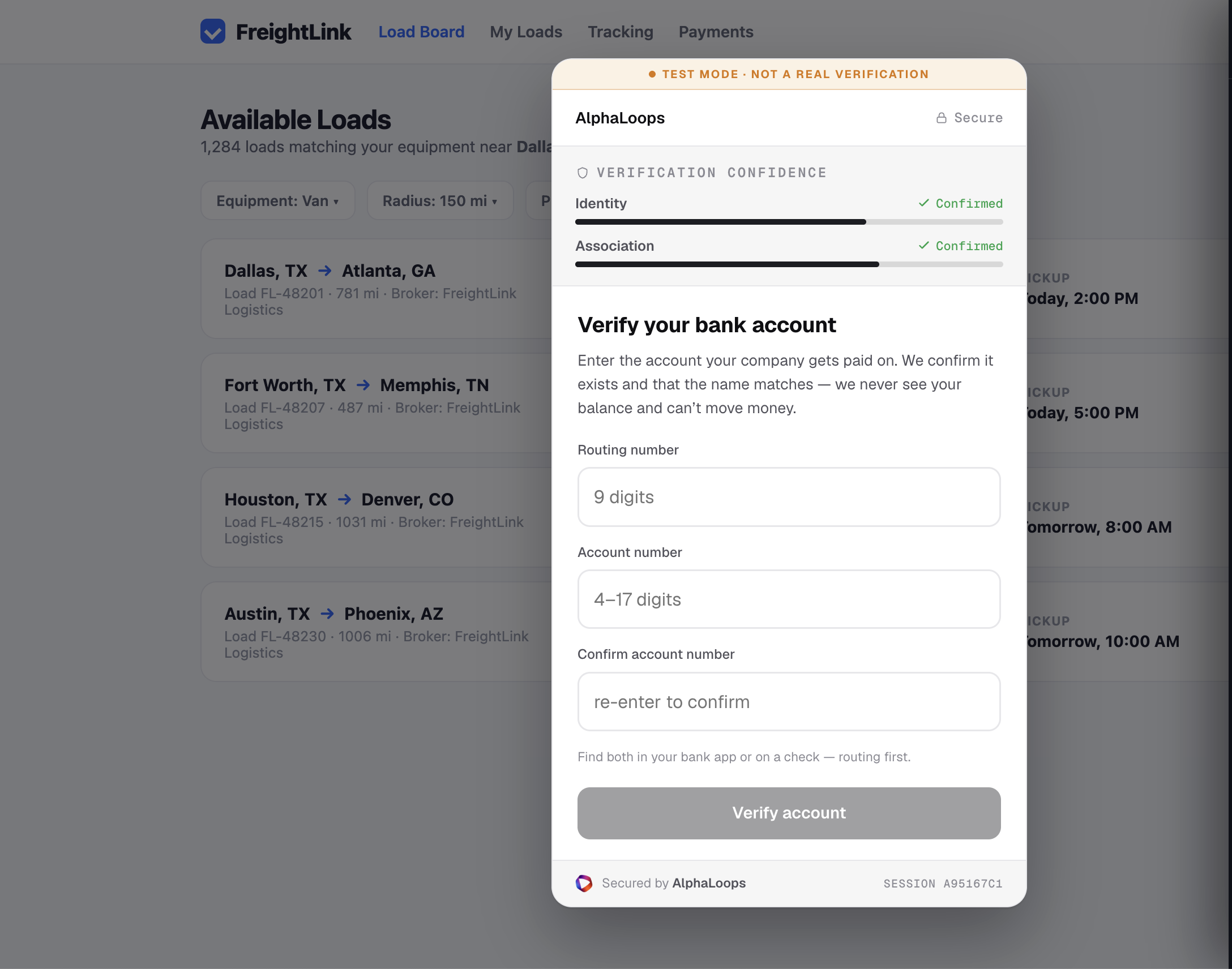
Verify now closes that gap. During onboarding, the carrier enters the account they get paid on (routing + account number), and we confirm two things instantly:
-
The account is real. It exists at the bank behind that routing number.
-
The holder matches the carrier. The name on the account lines up with the carrier's FMCSA record.
A few things make this more than a checkbox:
-
We match against FMCSA, not a name they type in. The carrier can't self-declare whose account it is. We compare the real account holder against the carrier's registered legal name, its DBA, and every listed company officer, so an owner-operator banking under their own name still comes back a match, while a mule account under an unrelated name does not.
-
It's evidence, not a gate. The result (strong match, partial match, or no match) never blocks the carrier. It lands on the verification for you to weigh against your own pay-to records and decide.
-
Privacy by design. We never store the account number. Only the last four digits, a one-way hash, and the match result are kept.
Digital Authorization
Sometimes verifying identity isn't enough. You need a record that the carrier authorized something, and that the record holds up later.
The new authorization step captures exactly that: a clear statement the carrier signs, bound to the identity they just proved.
-
The signature is tied to real identity. When a government ID was captured earlier in the flow, the signature is bound to the name on that ID. When it wasn't, it's bound to the phone number the carrier just proved they control, plus device evidence, and the record says honestly which basis was used.
-
Your words, our legal frame. You write the statement your carriers read and agree to. Verify wraps it in the ESIGN and possession mechanics that make an electronic signature stand up.
-
Reproducible, tamper-evident receipts. Every signed version is preserved exactly as the signer saw it and sealed with a tamper-evident signature. If a dispute ever arises, you can reproduce what was agreed, word for word.
-
Chain multiple statements when a single flow needs more than one authorization.
Where you'll see it
Both checks surface the same way everything else in Verify does: as evidence on the verification, visible in the console and delivered on the completion webhook, so they drop straight into the onboarding decisions and records you already keep.
Both are configurable per journey. Reach out to turn them on for your flows.