Today we're shipping AlphaLoops Carrier Benchmarks: a single letter grade, backed by six scored dimensions, on every graded carrier in the platform and on every carrier lookup through the API.
It's built to answer one question fast. Is this carrier safe relative to operations like its own? Not relative to the entire trucking industry, which is where most safety signals quietly go wrong.
Why we built it
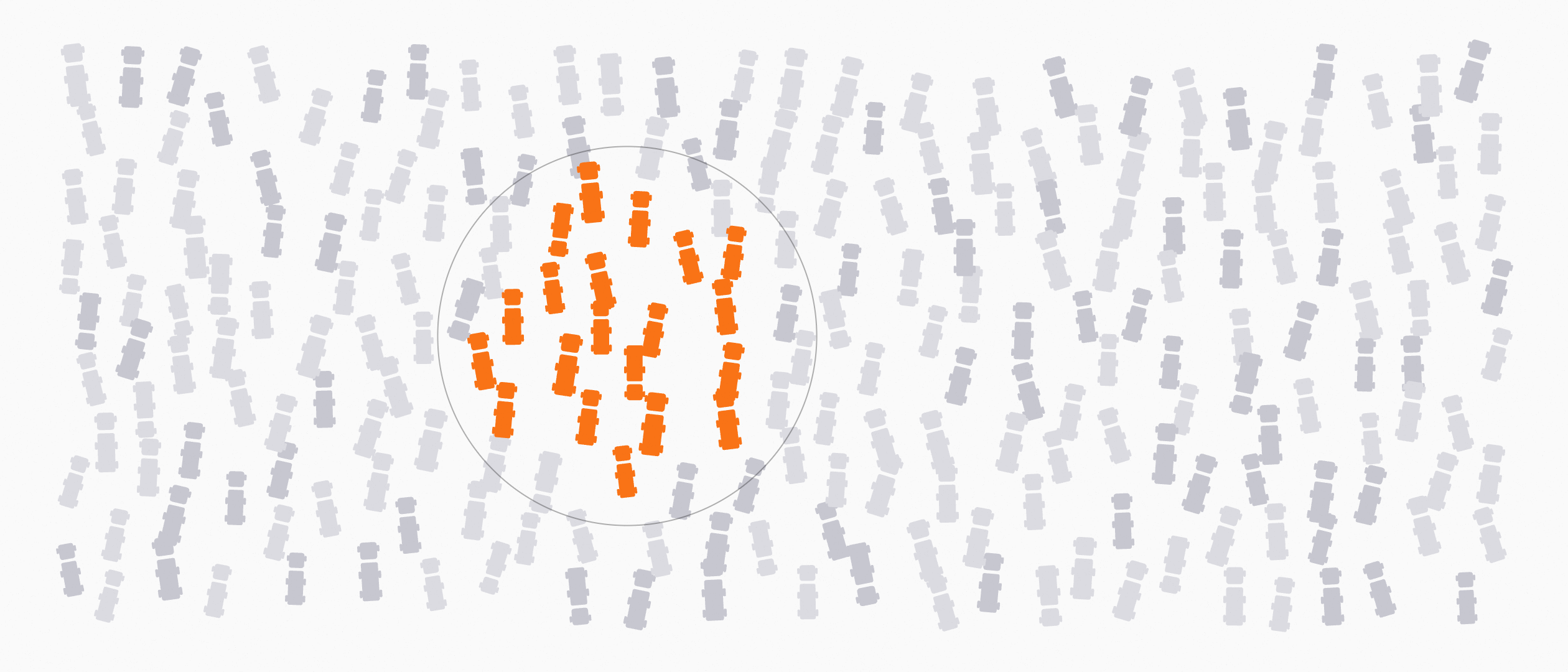
A violation rate that would sink a local flatbed outfit is a Tuesday for a national reefer fleet running twice the miles. Same number, opposite meaning.
Most safety tools can't tell those two carriers apart, because they hold every carrier to the same yardstick:
 Everything needed to tell them apart is already in the public FMCSA record. It's just vast, noisy, and never organized by who belongs next to whom. That's the part we built.
How this differs from CSA
CSA already compares carriers to peers, so this is the first question we get. The difference is what "peer" means.
FMCSA sorts carriers into five safety event groups based on how many relevant inspections or crashes they have. For Vehicle Maintenance, those groups run 5-10 inspections, 11-20, 21-100, 101-500, and 501+. One operational split exists, combination trucks versus straight trucks, and it applies only to Unsafe Driving and Crash Indicator. Beyond that, FMCSA states it plainly: safety event groups do not compare carriers by the commodities they haul or their industry segment.
That is the right design for what CSA does. Its job is to prioritize enforcement resources toward the highest crash risk, irrespective of industry segment. It was never built to tell a broker whether this flatbed is riskier than other flatbeds like it.
Carrier Benchmarks asks that second question of the same public record. A carrier's peer group is defined by how it operates, not by how many times it has been inspected.
FMCSA has approved a set of SMS changes, not yet in effect, that replace safety event groups with proportionate percentiles and extend segmentation to two more categories. The grouping would still be driven by event volume and coarse vehicle type.
What you get
-
One grade, A through F, on 778,905 graded carriers out of 2.3M active.
-
Six scored dimensions underneath it, each 0 to 100, where higher always means safer.
-
The peer group named on every score, so you can see exactly what a carrier was compared against.
-
An explicit confidence signal, so a thin record never gets dressed up as a confident one.
-
Fixed thresholds. A grade changes when the carrier's record changes, never because other carriers moved around it.
-
All of it in the API. The grade, the six dimensions, the matched peer group, and the confidence flag come back on the carrier response, so Carrier Benchmarks can drive an underwriting rule or a lead score without anyone opening a browser.
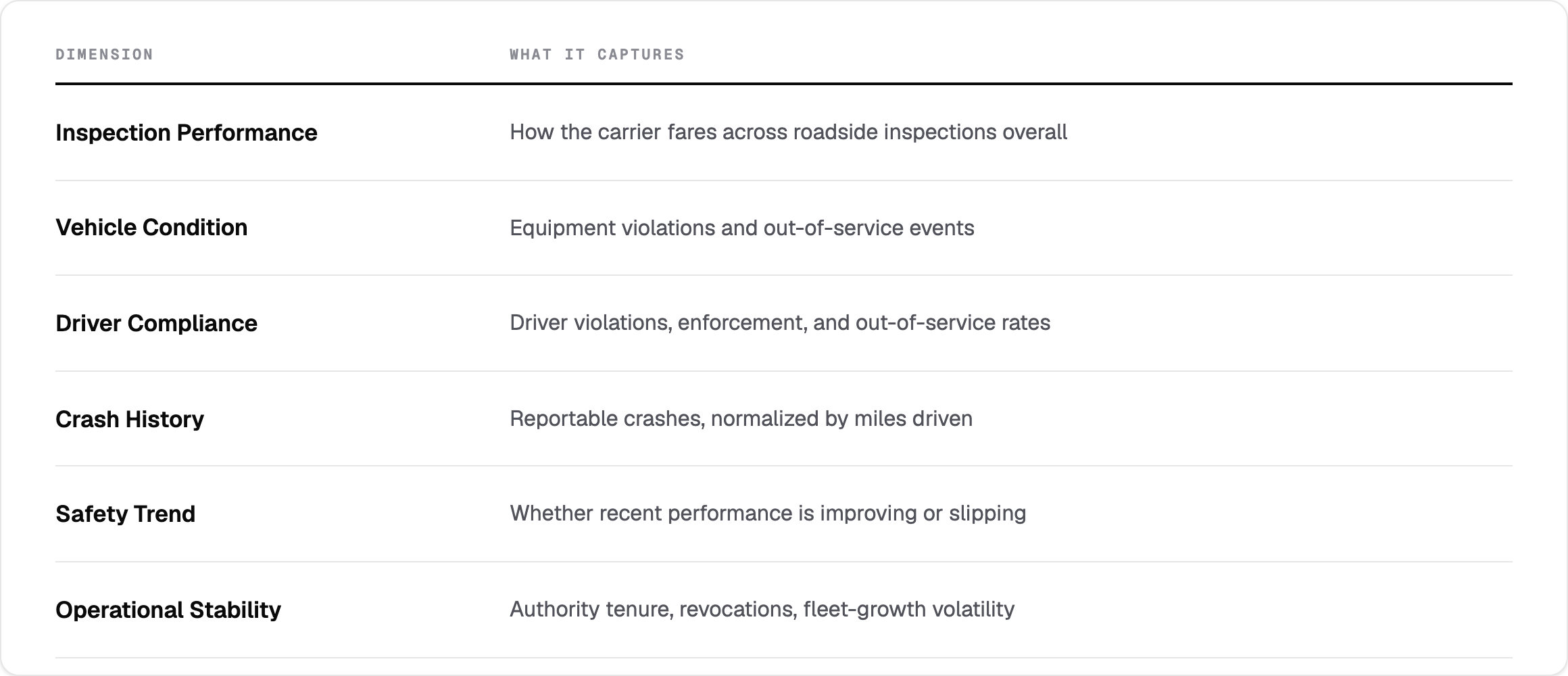
Crash History carries the heaviest weight of the six. It's the dimension that should move a grade the most, and the pipeline is built so it does.
How the peer matching works
The trucking universe isn't one population, it's thousands. So instead of one comparison, we maintain multiple ways to group carriers and match each one to the most specific group that still has enough peers behind it, tried in this order:
-
Fleet size × operating radius. A small local isn't held to a national long-haul bar.
-
Carrier type × region. For-hire vs. private, and where they run.
-
Equipment profile. Reefer, flatbed, tanker, dry van, and the risk baked into the freight.
-
The whole graded industry. The fallback that never runs short.
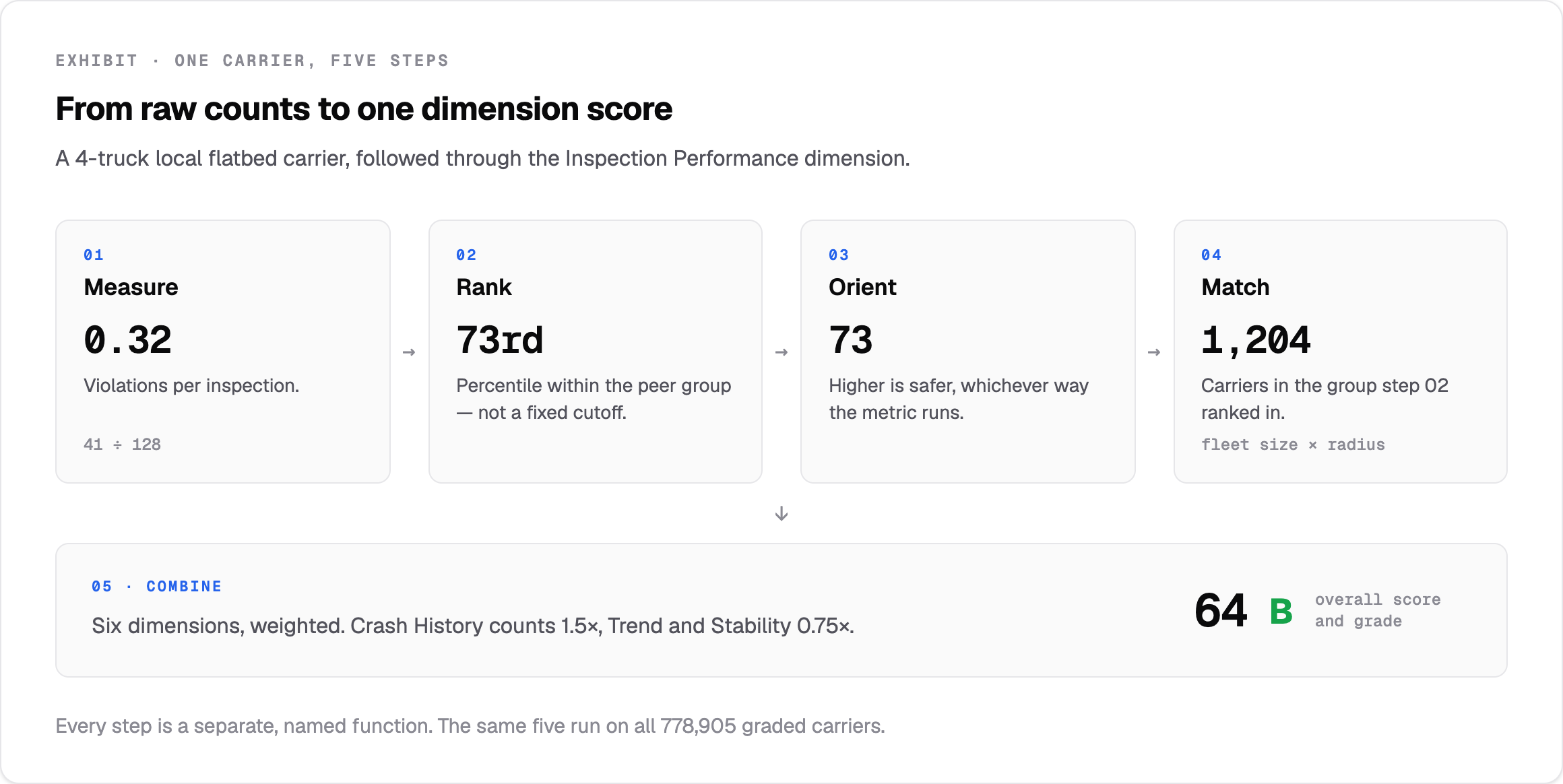
Once a carrier is matched, the scoring itself is five small, auditable steps. Measure turns raw counts into fair rates. Rank finds where that rate falls in the peer group's distribution. Orient flips it so higher always means safer. Match holds the group it was scored against. Combine rolls the six dimensions into one weighted number.
 Before scoring against any group, we require at least 384 carriers in it. That's the sample size at which a proportion is accurate to within ±5 points at 95% confidence, not a round number that sounded about right. Below it, the edges of the distribution get shaky, and the edges are exactly where "is this carrier an outlier?" gets decided.
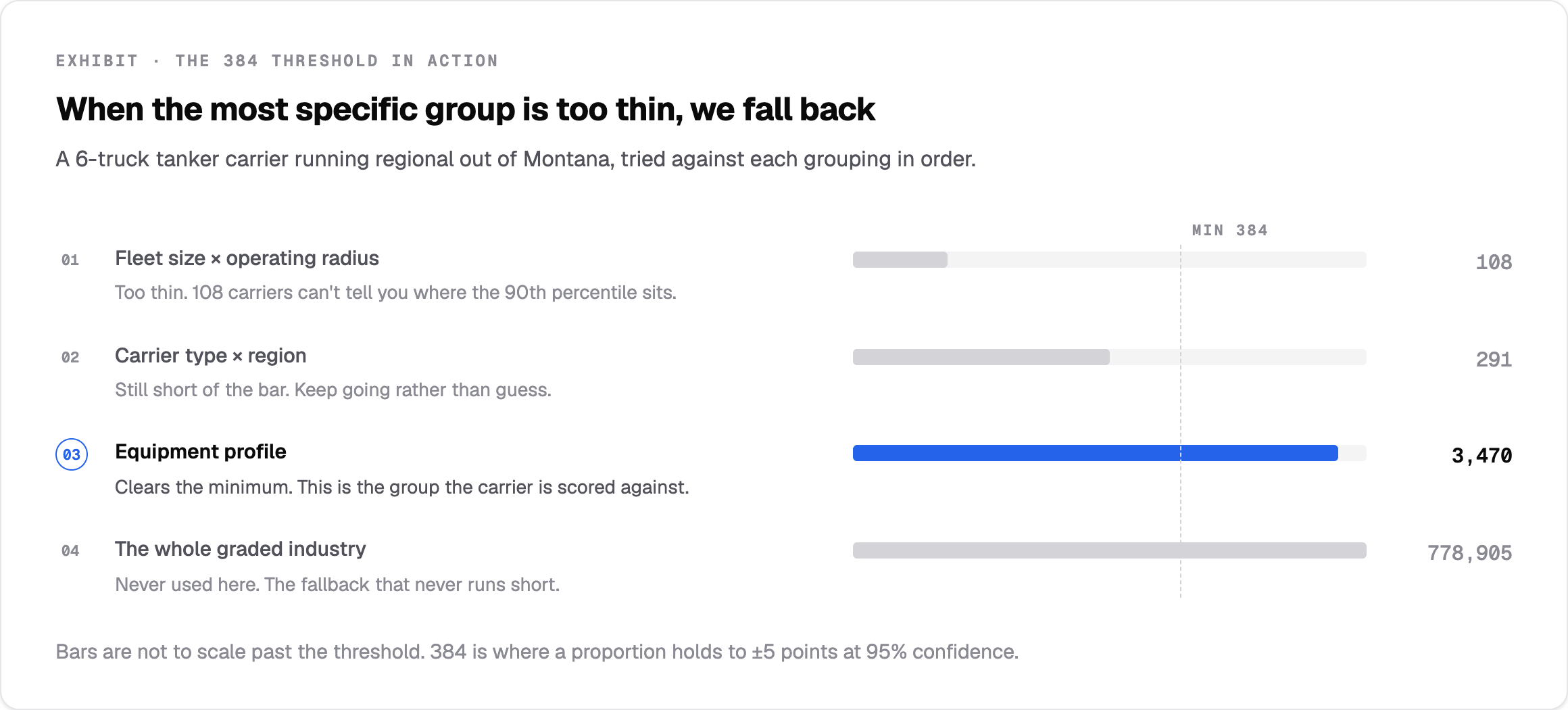 The safety net rarely fires. Across two-axis peer groups, the pairing that falls back most often is Fleet Size × Equipment, at 6% of cases. Most comparisons never need it.
A fifth lens, fleet composition × mileage, is available to compare against by hand on every carrier profile, but doesn't yet feed the automatic match.
Grades that mean something
We grade on the real distribution, not a classroom curve. Most carriers cluster in the safe range, so a mid-50s score isn't a near-failing grade, it's the middle of the pack. We set the cut points so the median carrier earns a B.
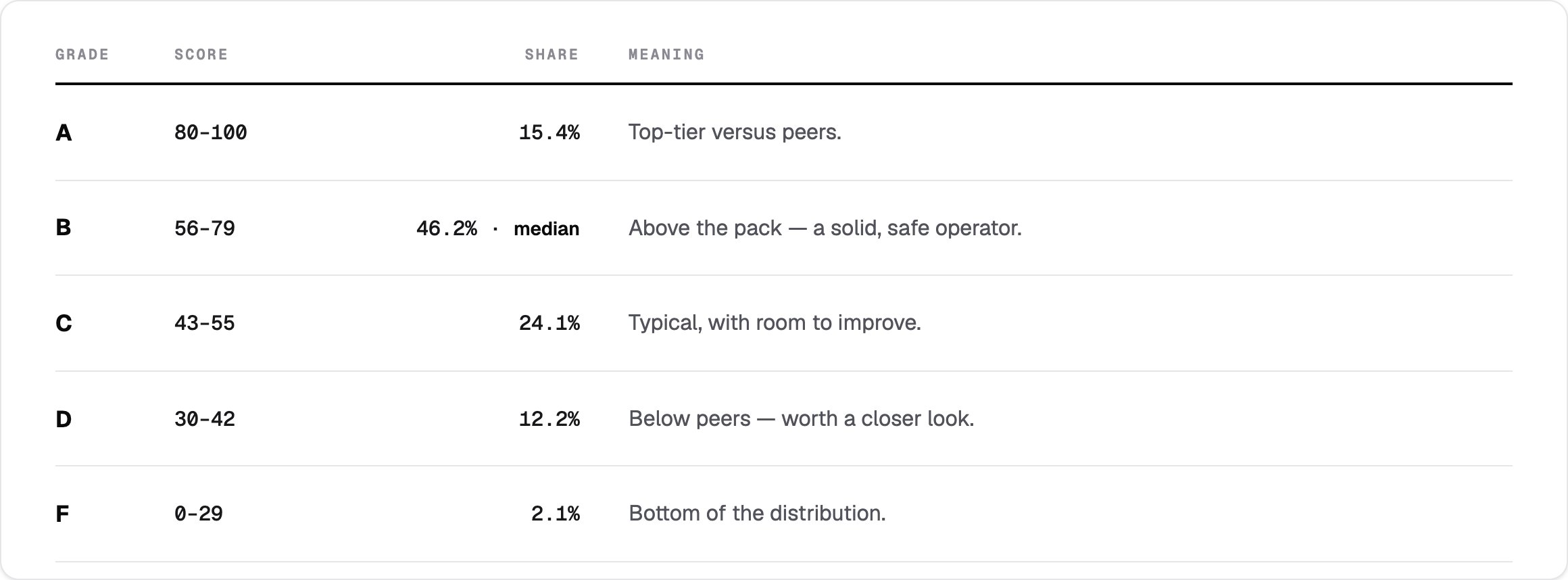 Checked against all 778,905 graded carriers, the median score lands at 60.7, squarely inside the B band. B is both the most common grade and the statistical median, by design rather than coincidence.
Where to find it
Carrier Benchmarks is live now in three places, with no separate call or upgrade needed:
-
API. Every carrier lookup returns the grade, the six dimension scores, the peer group each was matched against, and the confidence flag. Nothing extra to request, no separate endpoint to integrate.
-
Carrier profiles and the vetting report. The same grade, with the peer group and method shown next to each dimension so it can be read and defended by a human.
-
Your systems. Because it rides along on the standard carrier response, Carrier flows through the existing MCP server, Salesforce sync, Zapier, and n8n integrations without new plumbing.
What it is not
-
Not a CSA or SMS score. Independent method, built from raw inspection, violation, and crash counts. We don't restate FMCSA's compliance ratings or its safety rating.
-
Relative, not a verdict. A B means "above the pack for this peer group." An F is a prompt to look closer, not a legal conclusion.
-
Never invented. Where the public record lacks a detail, the report says so instead of filling the gap with an assumption.
What's next
We don't yet have an independent re-implementation check, a from-scratch distribution reconciliation, or a measured approximation error. Those are real gaps in how we verify this pipeline, not settled facts we're choosing not to publish. We'll add them and publish the results alongside the code that produced them.
The full methodology, including the confidence surface by fleet size and mileage and the complete measure-rank-orient-match-combine pipeline, is documented here: