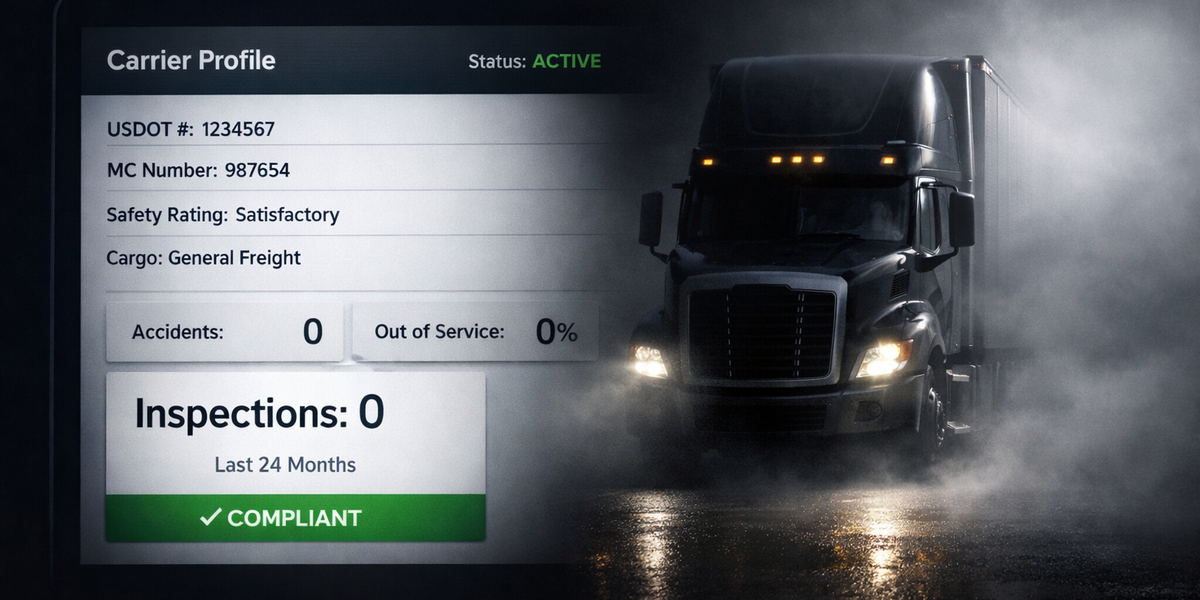
A carrier with zero inspections can look safer than it really is.
That is the trap.
FMCSA’s SAFER Company Snapshot shows a carrier’s inspection and crash summary, and the inspection counts displayed there reflect the previous 24 months of roadside inspection activity rather than a full company history. FMCSA also notes that these are roadside inspections, which are distinct from the periodic inspections required under federal maintenance rules.
So when a carrier shows no inspections, that does not automatically mean the company is low risk. It may mean the carrier is very new, has had limited roadside exposure, has a thin operating footprint, or simply has too little public safety history to evaluate with confidence. FMCSA’s company safety records guidance makes clear that the snapshot is a concise record of identification, size, cargo, inspection and out-of-service summary, crash data, and safety rating if any — useful, but still limited.
In this guide, we’ll cover:
-
what “no inspections” actually means
-
when zero inspections should raise concern
-
the biggest red flags to watch for
-
how to vet a no-inspection carrier more carefully
-
what a clean-looking record can miss
What does “no inspections” mean on a carrier record?
In SAFER, the Company Snapshot includes a roadside inspection summary and crash information for the company. FMCSA explains that the snapshot is a concise electronic record of a company’s identification, size, commodity information, and safety record, including the safety rating if any, a roadside out-of-service inspection summary, and crash information.
FMCSA’s SAFER FAQ adds an important detail: the inspection and crash counts displayed on the snapshot are for the previous 24-month period prior to the most recent weekly calculation.
That means “0 inspections” usually means:
-
no roadside inspections recorded in the displayed 24-month window
-
not necessarily no operations
-
not necessarily no internal maintenance inspections
-
not necessarily low risk
FMCSA also specifically distinguishes these roadside inspections from the periodic inspections required under 49 CFR Part 396.17.
Why a no-inspection carrier can be risky
Inspection history is not a perfect safety measure, but it is still one of the few public signals showing that a carrier has real roadside operating history.
FMCSA explains that inspection data is used in its broader safety monitoring, and even inspections with no violations are still added to the system; those clean inspections can improve a carrier’s SMS data.
That matters because a carrier with no inspections gives you less evidence on questions like:
-
has this fleet actually been operating consistently?
-
has it had roadside exposure?
-
have any clean inspections helped establish a safety footprint?
-
does the company’s public story match visible activity?
A zero-inspection profile is not automatically a red flag. But it is often a sign that you are evaluating a carrier with limited observable history, which should make your vetting process more careful rather than more relaxed.
When zero inspections should raise concern
1. The carrier is new and already pitching broad capability
FMCSA’s systems include a dedicated “new carriers” context within CSA resources, reflecting that newly registered carriers have different levels of public history and oversight context than established operators.
A new authority with zero inspections is not unusual by itself. It becomes more concerning when the company is simultaneously claiming:
-
nationwide reach
-
broad equipment capacity
-
immediate availability across many lanes
-
established operational depth with no visible footprint
The issue is not “new.” The issue is whether the operating story is too mature for the amount of public evidence available.
2. The company looks polished, but thin
A no-inspection carrier may still have:
-
an active DOT number
-
authority on file
-
a clean-looking SAFER profile
-
professional documents
-
responsive dispatch
That can create false confidence. FMCSA’s public tools are useful, but the snapshot itself is still just a concise record of selected safety and company data. A profile can look clean simply because there is not much history showing up yet.
3. There is little else supporting the operating story
Zero inspections becomes riskier when paired with:
-
no meaningful crash history
-
minimal fleet visibility
-
unclear operating geography
-
vague answers about equipment or lanes
-
inconsistent company details
A carrier does not need a giant inspection count to be legitimate. But when inspections are absent, other evidence matters more.
What zero inspections does not mean
It is just as important to avoid overreacting.
A carrier with no inspections is not automatically fraudulent, unsafe, or unqualified. The SAFER snapshot reflects a defined 24-month window, and activity counts are updated on a schedule rather than in real time. SAFER says Company Snapshot activity counts for inspections and crashes are updated once a week.
So a zero-inspection profile can also reflect:
-
a relatively new operation
-
limited roadside encounters in the visible period
-
delayed appearance of updated activity
-
a smaller or narrower operating footprint
The right response is not automatic rejection. The right response is better verification.
7 signs a no-inspection carrier deserves closer scrutiny
1. Very recent authority
A recently granted DOT or MC profile with no inspections is common, but it means there is less operating history to evaluate.
2. Big claims with little proof
Be cautious when the carrier claims broad scale, mature operations, or extensive lane coverage that is not supported by the profile.
3. No inspections plus no believable operating footprint
A carrier with zero inspections and little other visible evidence should be reviewed more carefully.
4. Inconsistent company details
If the address, contacts, equipment story, or role shift across documents and conversations, that matters more when the inspection record is empty.
5. Unclear dispatch or contact structure
Weak or inconsistent contact details are often a bigger signal when there is no roadside history backing up the company profile.
6. A profile that feels “too clean”
A spotless profile can be a function of limited data rather than proven safety.
7. Multiple small concerns appearing together
Zero inspections alone is one thing. Zero inspections plus urgency, inconsistency, or odd authority details is another.
These are judgment signals, not automatic disqualifiers — but they are exactly the kind of signals your team should use to escalate review.
How to vet a no-inspection carrier more carefully
Step 1: Confirm the basics
Start by verifying:
-
legal company name
-
USDOT number
-
MC number
-
address
-
phone
-
email
-
authority status
FMCSA makes clear that users should use SAFER for company snapshots and Licensing & Insurance for licensing and insurance status.
Step 2: Check whether the authority timeline makes sense
If the carrier is brand new, zero inspections may be expected. If the carrier presents itself as long-established, that same zero may be harder to explain.
Step 3: Pressure-test the operating story
Ask whether the carrier’s:
-
fleet size
-
equipment type
-
lane coverage
-
dispatch setup
-
customer story
actually fits what you would expect from a company with no visible roadside inspection history.
Step 4: Look for consistency everywhere else
When inspection history is absent, consistency matters more. Compare:
-
email domain vs company name
-
phone number vs stated geography
-
documents vs public record
-
dispatch contact vs registered identity
Step 5: Escalate if the story still feels thin
If the carrier has no inspections and not enough other evidence to make the operation feel credible, pause and review more deeply before tendering freight.
The biggest mistake teams make
The biggest mistake is treating zero inspections like a positive signal by default.
FMCSA’s own materials show that the snapshot is a compact, limited view and that inspections are one part of a broader safety and compliance picture. Clean inspections can improve a carrier’s SMS data, which means no inspections can also mean no opportunity to build that visible public track record.
In other words:
-
some carriers are risky because they look bad
-
others are risky because there is too little evidence to know
A no-inspection carrier often falls into the second category.
A practical checklist for no-inspection carrier risk
Before booking a load with a carrier showing zero inspections, ask:
-
Is the carrier very new?
-
Does the authority timeline make sense?
-
Does the company’s scale match the amount of public history?
-
Are the contact and identity details consistent?
-
Does the operating story hold up without inspection evidence?
-
Are there any other red flags that make the thin profile more concerning?
If several of those answers are weak, the issue is not just “no inspections.” The issue is not enough confidence.
What FMCSA data can tell you — and what it cannot
FMCSA’s public systems are valuable for checking company identity, safety record summary, crash data, safety rating if any, and licensing/insurance status. SAFER and related tools are explicitly designed for those purposes.
But a no-inspection profile may still leave major questions unanswered:
-
Is this company truly established?
-
Does it actually operate the way it claims?
-
Is the lack of inspections normal for its profile?
-
Are there related-entity or credibility issues that do not appear in the snapshot?
That is why no-inspection carrier risk is really a context problem, not just a count problem.
How AlphaLoops helps
A no-inspection carrier is hard to evaluate if your team is forced to rely on a thin public snapshot alone.
AlphaLoops helps teams go beyond the basic record by adding more context around:
-
carrier identity
-
authority review
-
operating credibility
-
related signals
-
risk indicators
-
whether the company’s story makes sense
The goal is not to punish carriers for being new. It is to avoid mistaking a lack of public evidence for proof of safety.