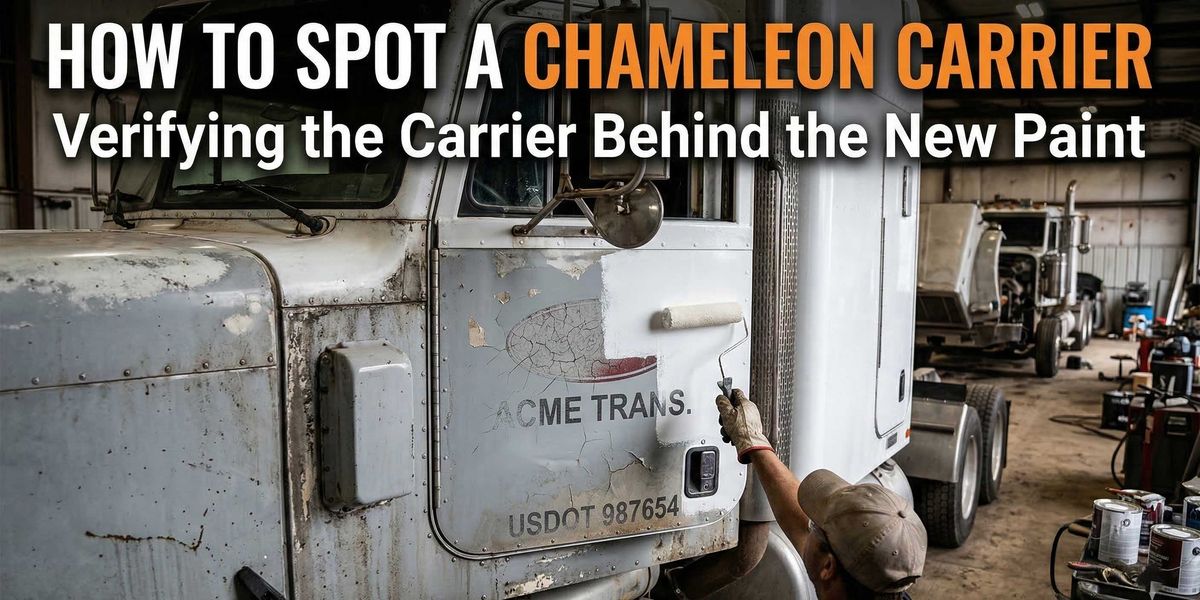
A carrier can look clean on paper and still be a major risk.
That is the core problem with chameleon carriers. A bad actor shuts down one trucking company after safety issues, insurance problems, fraud complaints, or enforcement action — then reappears under a new name, new DOT number, new MC authority, or slightly altered ownership structure.
On the surface, the new entity may look fresh. In reality, it may be the same operation with the same people, same equipment, same contact information, and the same underlying risk.
The FMCSA has long treated chameleon carriers as a serious enforcement issue. In its report to Congress, the agency described a risk-based methodology for identifying carriers that are effectively reincarnations or affiliates of previously regulated entities, and noted that federal rules allow the agency to act against carriers that reincarnate or affiliate to avoid compliance obligations.
If you are vetting carriers using only the current DOT snapshot, you can miss the story that matters most: who this company used to be.
In this guide, we’ll break down:
-
what a chameleon carrier is
-
why they are dangerous
-
the biggest red flags to watch for
-
how to investigate one step by step
-
what FMCSA data alone can miss
What is a chameleon carrier?
A chameleon carrier is a trucking company that appears to be a new business, but is actually a reincarnation, affiliate, or continuation of another carrier — often one with a poor safety history, revoked authority, unpaid claims, fraud allegations, or regulatory problems.
FMCSA’s enforcement framework specifically addresses carriers that are “reincarnations or close affiliates” of other regulated entities used to avoid compliance requirements or out-of-service consequences.
In plain English, that usually means some version of this:
-
the old company gets shut down or becomes unusable
-
ownership or control shifts on paper
-
a new company appears with a clean-looking profile
-
the same people keep operating
That is why chameleon carriers are so dangerous: they are built to make a risky operation look new.
Why chameleon carriers matter
The risk is not just technical or regulatory. It is operational.
A chameleon carrier can expose brokers, shippers, and 3PLs to:
-
cargo theft
-
double brokering
-
unsafe operations
-
insurance gaps
-
service failures
-
claims headaches
-
reputational damage
-
negligent selection exposure
The challenge is that many of the most important warning signs are not obvious in a single record. Some are buried in contact data, registration history, reinstatements, authority timing, equipment patterns, inspection history, or relationships between entities.
Even competitor content aimed at brokers now emphasizes that some of the biggest warning signs show up in FMCSA records, DOT safety inspection data, and inconsistent company details rather than in one obvious “fraud” flag.
9 red flags that may indicate a chameleon carrier
1. Brand-new authority with an oddly polished operation
A new authority is not automatically suspicious. Plenty of legitimate carriers are newly established.
But you should slow down when a carrier has:
-
very recent authority
-
little or no inspection history
-
no meaningful operating footprint
-
yet presents itself like a fully mature fleet
Examples:
-
a “new” carrier that claims nationwide coverage immediately
-
a company with almost no visible history but a sophisticated sales pitch
-
a brand-new authority claiming long-term lane expertise or large fleet capacity
A clean record can be a sign of freshness — or a sign that the old record was left behind.
2. Shared phone numbers, emails, or addresses across multiple entities
This is one of the strongest signals.
If the “new” carrier shares:
-
the same phone number
-
the same dispatch email
-
the same physical address
-
the same mailing address
-
the same registered agent patterns
-
the same domain ownership or site fingerprints
with an older or problematic entity, that deserves immediate scrutiny.
A chameleon carrier often changes the company shell before it changes the operational reality.
Look especially hard at:
-
Gmail addresses used across multiple entities
-
mailbox stores or virtual office addresses
-
mismatches between address, area code, and claimed operating geography
-
recycled dispatch lines
3. Ownership changes that look cosmetic
Sometimes the paper trail says the company is different, but the business clearly is not.
Watch for:
-
a spouse, relative, or associate replacing the former owner
-
similar names across related entities
-
ownership transfer immediately after revocation, shutdown, or claims trouble
-
overlapping managers, dispatchers, or signatories
The key question is not just “who owns it now?” but who appears to control it in practice?
4. Old equipment, new company
A new authority operating equipment that appears tied to an older carrier is a major clue.
That can include:
-
trucks previously associated with another entity
-
trailers or plates tied to older records
-
equipment counts that do not match the company’s age
-
lane behavior inconsistent with a truly new operator
A company that supposedly launched last month but is clearly moving like an established operation may not actually be new.
5. Strange revocation, reinstatement, or authority timing
Authority history matters.
You should look more closely when you see:
-
revoked authority followed by a fast reappearance
-
reinstatement patterns that do not make operational sense
-
multiple connected entities with similar timing
-
abrupt transitions between inactive and active records
-
frequent legal-name or structure changes around regulatory events
These patterns do not prove fraud on their own, but they often show where to dig.
6. No inspections, no operational footprint, but aggressive booking behavior
One classic chameleon or fraud pattern is a carrier that is active in the market before it has a believable operational history.
Examples:
-
no meaningful inspection history
-
little roadside visibility
-
no equipment evidence
-
yet aggressively pursuing loads or presenting broad capability
That does not always mean it is a chameleon carrier. But it does mean you should ask: how is this carrier proving it actually operates what it claims to operate?
7. Inconsistent company story
Listen for inconsistency.
A risky carrier may tell one story on the phone, another in onboarding documents, and another in public data.
Watch for:
-
conflicting fleet sizes
-
vague answers about equipment
-
changing descriptions of lanes or freight types
-
insurance details that do not line up cleanly
-
inability to explain company history
Fraudulent or reincarnated operators often struggle when asked detailed follow-up questions because the surface story is assembled faster than the underlying facts.
8. The carrier looks “too clean”
Counterintuitively, a profile that looks perfect can be its own warning sign.
A carrier with:
-
no safety blemishes
-
no meaningful operating history
-
no visible market footprint
-
no negative signals anywhere
-
but very active load-seeking behavior
may not be a low-risk carrier. It may just be a new shell.
This is one reason surface-level FMCSA checks are not enough.
9. Signs of sold authority or recycled operating identity
Some of the most concerning cases involve an MC authority or operating identity changing hands informally or being marketed for sale.
That matters because the operating identity may retain the appearance of legitimacy while the people behind it change entirely.
FMCSA has explicitly described chameleon-carrier enforcement as involving reincarnations or affiliates used to avoid compliance consequences, and AlphaLoop’s own watchlist thesis is built around the idea that authority sales and recycled identities can be an early risk signal. FMCSA’s framework focuses on the relationship between entities — not just the existence of a current registration.
How to investigate a suspected chameleon carrier
Here is a practical process your team can use.
Step 1: Check the basics, but do not stop there
Start with:
-
DOT number
-
MC number
-
legal name
-
DBA name
-
authority status
-
insurance status
-
inspection history
-
power units and drivers
-
address and contact info
This gives you the surface profile. It does not tell you whether the entity is related to a prior bad actor.
Step 2: Compare contact details against other entities
Look for overlap in:
-
phone numbers
-
email addresses
-
domains
-
addresses
-
mailing addresses
-
contact names
This is often where the real story starts to show.
Step 3: Check for timeline weirdness
Ask:
-
How old is the authority?
-
When did the company become active?
-
Does the operating story make sense for that timeline?
-
Did another related company disappear right before this one appeared?
Step 4: Pressure-test the operating claims
Verify:
-
fleet size
-
equipment types
-
lane fit
-
geographic logic
-
dispatch setup
-
insurance sufficiency
-
whether their operating footprint matches their sales pitch
Step 5: Look for related-entity evidence
This is the big one.
Investigate whether the carrier appears linked to:
-
prior revoked carriers
-
out-of-service entities
-
companies with severe safety records
-
companies with similar names or addresses
-
businesses with matching principals or contact info
FMCSA’s own approach to chameleon-carrier identification is based on evaluating relationship factors between entities, not just analyzing one company in isolation.
Step 6: Escalate when the pattern does not make sense
A single flag may not be enough to decline a carrier.
But several together should trigger:
-
additional verification
-
manager review
-
load hold
-
manual document validation
-
direct insurance verification
-
related-entity investigation
What FMCSA data can miss
FMCSA data is essential, but it is not the whole picture.
A standard snapshot may tell you:
-
whether authority is active
-
how many inspections are recorded
-
whether insurance appears on file
-
certain core census and safety details
What it may not clearly tell you on its own is:
-
whether a “new” carrier is tied to an older risky one
-
whether the same contact data appears across multiple entities
-
whether the business identity is being recycled
-
whether the authority was recently transferred, marketed, or informally sold
-
whether the company’s real-world activity matches its paper profile
That is why chameleon-carrier risk is fundamentally a network problem, not just a record-check problem.
A simple internal checklist for brokers and shippers
Before onboarding a carrier that feels “new but oddly polished,” ask:
-
Is the authority very new?
-
Does the inspection history support the operating story?
-
Do phone, email, or address details connect to other entities?
-
Are there any suspicious revocation/reinstatement patterns?
-
Does the company story stay consistent under follow-up questions?
-
Does the fleet/equipment claim make sense?
-
Is there evidence this may be a recycled identity rather than a truly new operation?
If multiple answers are unclear, pause.
How AlphaLoop helps spot chameleon carriers
Spotting a chameleon carrier is hard if your team is forced to investigate one record at a time.
The real signal usually comes from relationships:
-
shared contact data
-
related entities
-
suspicious authority patterns
-
watchlist activity
-
operating inconsistencies
-
too-clean new identities
That is the problem AlphaLoop is built to solve.
Instead of treating every DOT number as a blank slate, AlphaLoop helps teams investigate the context around a carrier — including the clues that often sit outside a single FMCSA snapshot.