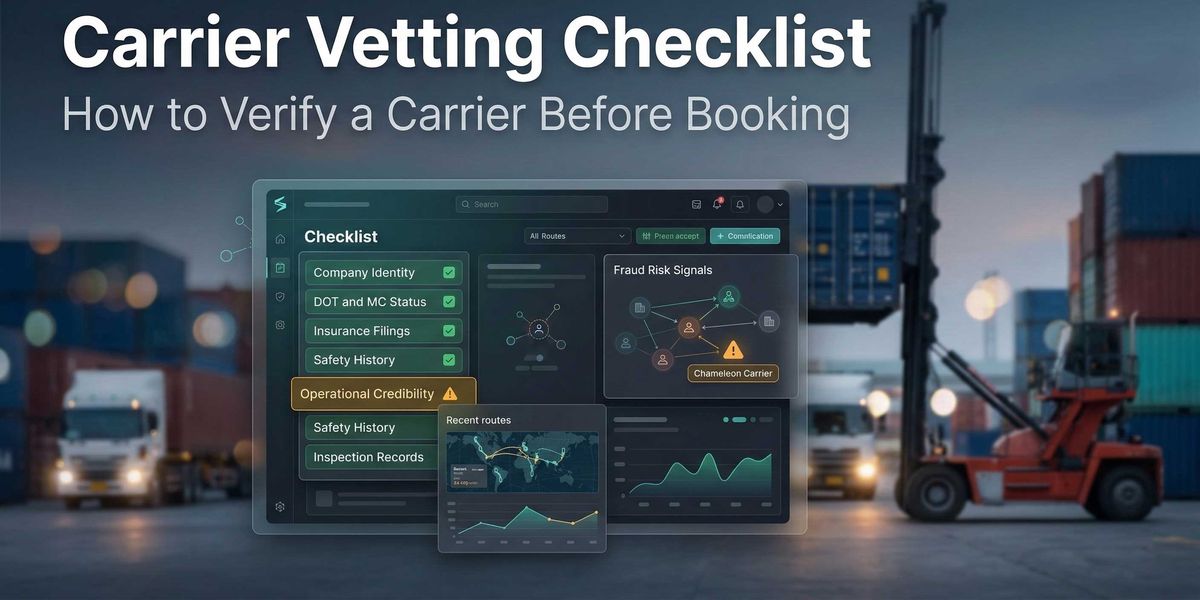
How to vet a carrier before booking a load (10-step checklist)
To vet a carrier before booking a load, work this checklist in order before you tender freight:
-
Verify legal identity: legal name, DBA, USDOT number, MC number, physical and mailing address, phone, and email all match the public record.
-
Check the DOT number: confirm the company match, operating status, interstate vs intrastate profile, and that inspection and crash history fit the claimed size.
-
Check MC authority: confirm authority is active (not pending, inactive, or revoked) and that the authority type matches the role the company claims.
-
Verify insurance filings: confirm insurance is on file, complete, and free of recent cancellations or pending changes that do not add up.
-
Review safety and inspection history: a profile that is too thin for the claimed experience needs more verification.
-
Pressure-test the operating story: fleet size, equipment, lanes, and years in business should line up across every source.
-
Review contact details: watch for generic email domains, recycled phone numbers, shared contact data, and addresses that do not fit the geography.
-
Watch for new-authority risk: new is not bad, but new plus no history plus broad claims warrants more questions.
-
Check for chameleon and related-entity signals: overlapping phones, emails, addresses, or cosmetic ownership changes across DOTs.
-
Escalate when multiple things do not add up: hold the load, verify insurance directly, and do not onboard until concerns resolve.
A DOT number check is a starting point, not a full verification. The goal of vetting is not to eliminate all risk. It is to avoid the risks that were visible before the load was booked.
Important: how to read this guide
This guide is informational and is not legal advice. Consult your attorney on how these issues apply to your specific operations. We do not guarantee that any carrier is safe to tender to. The decision remains the broker's. A transferred or sold authority is not automatically improper, and a sold authority is not the same thing as identity theft.
What is a carrier vetting checklist?
A carrier vetting checklist is a standardized process used to evaluate whether a trucking company is legitimate, qualified, and safe to work with before booking or onboarding.
A strong checklist helps your team review:
-
company identity
-
DOT and MC information
-
authority status
-
insurance filings
-
safety history
-
inspection history
-
operational credibility
-
fraud red flags
-
related-entity risk
It is the difference between a quick lookup and an actual vetting process.
Why carrier vetting matters
Carrier vetting is one of the few points in the freight workflow where risk can still be prevented instead of managed after the fact.
Weak vetting can lead to:
-
freight fraud
-
double brokering
-
cargo theft
-
claims issues
-
service failures
-
unsafe carrier selection
-
reputational damage
-
preventable customer problems
The goal of vetting is not to eliminate all risk. It is to avoid the risks that were visible before the load was booked.
Carrier vetting checklist
Use the checklist below as your baseline process before onboarding or tendering a load to a carrier.
1. Verify the carrier’s legal identity
Confirm the basics first:
-
legal company name
-
DBA name
-
USDOT number
-
MC number
-
physical address
-
mailing address
-
phone number
-
email address
Ask: does the public record match the information the carrier gave you?
If there are mismatches this early, do not brush them off.
2. Check the DOT number
Look up the USDOT number and review the company snapshot.
Check for:
-
correct company match
-
operating status
-
interstate vs intrastate profile
-
inspection history
-
crash history
-
fleet size and driver count
-
whether the operating story feels believable
A DOT number check is a starting point, not a full verification.
3. Check the MC number and authority status
Do not assume that a DOT number means the carrier has the authority required for the work.
Review:
-
whether authority is active
-
whether it is pending, inactive, or revoked
-
authority history
-
whether the authority type matches the role the company claims to play
This is one of the most important steps in the process.
4. Verify insurance filings
Check that the carrier’s insurance filing status is reflected appropriately and matches the operating context.
Review:
-
whether insurance is on file
-
whether anything looks incomplete
-
whether there are pending changes or cancellations
-
whether the timing of recent updates feels clear and credible
Do not rely only on the carrier saying, “We’re covered.”
5. Review safety and inspection history
Look at the company’s operating footprint, not just whether the profile looks clean.
Ask:
-
does the carrier have inspection history?
-
does the crash history make sense for the age and size of the fleet?
-
is the company supposedly experienced but barely visible in the data?
-
is the profile so clean that it looks suspiciously thin?
A thin profile is not automatically bad, but it often means you need more verification.
6. Pressure-test the company story
Compare what the carrier says with what the data suggests.
Check whether the following line up:
-
fleet size
-
equipment type
-
geographic footprint
-
claimed lanes
-
years in business
-
dispatch setup
-
operating sophistication
If the story shifts depending on where you look, slow down.
7. Review contact information closely
This step is often underrated.
Pay close attention to:
-
generic email domains
-
recycled phone numbers
-
shared contact data across entities
-
virtual office addresses
-
mailbox store addresses
-
area codes that do not fit the operating geography
Contact information often reveals more than the carrier profile itself.
8. Watch for new-authority risk
A new authority is not automatically a red flag.
But it should trigger additional questions when paired with:
-
no inspection history
-
an unusually polished sales pitch
-
broad claimed coverage immediately
-
limited operating footprint
-
inconsistent answers about the business
The issue is not that the carrier is new. The issue is whether the operating story makes sense for a truly new company.
9. Look for signs of a chameleon carrier
A risky operator may shut down one entity and reappear under another.
Watch for:
-
overlapping phone numbers
-
overlapping email addresses
-
similar legal names
-
shared addresses
-
ownership changes that look cosmetic
-
suspicious timing between old and new entities
Do not treat every DOT number as a blank slate.
10. Check for fraud signals
Before booking, ask whether anything suggests:
-
double brokering
-
identity recycling
-
sold authority
-
impersonation
-
document inconsistency
-
urgency that bypasses normal process
Fraud often shows up as a pattern of small oddities, not one giant red flag.
11. Verify operational credibility
This is the practical layer many teams skip.
Ask:
-
can this carrier realistically perform this load?
-
does the equipment match the freight?
-
do the lanes fit the operation?
-
does the size of the fleet support the promises being made?
-
does the company feel operationally real?
A carrier can pass administrative checks and still be a bad fit or high-risk choice.
12. Escalate when multiple things do not add up
One small inconsistency may not be decisive.
But multiple unclear signals should trigger:
-
manager review
-
load hold
-
direct insurance verification
-
deeper related-entity research
-
a decision not to onboard until concerns are resolved
The point of a checklist is not to create false certainty. It is to create disciplined escalation.
The biggest mistakes teams make during carrier vetting
Mistake 1: treating FMCSA as the whole investigation
Public FMCSA data is essential, but it is still just the beginning.
Mistake 2: moving too fast because the carrier sounds professional
A polished presentation does not equal low risk.
Mistake 3: assuming a clean profile means a safe profile
Sometimes “clean” really means “new” or “thin.”
Mistake 4: checking authority without checking fit
A carrier may have authority and still not make sense for the load or the story they are telling.
Mistake 5: ignoring related-entity clues
Some of the most important risks appear in the connections between companies, not in one record by itself.
A simplified carrier vetting checklist for daily use
If you want a shorter version for internal use, use this:
-
Confirm legal name, DOT, MC, address, and contact info
-
Check DOT record and company snapshot
-
Check authority status
-
Verify insurance filing status
-
Review inspection and crash history
-
Compare the operating story to the data
-
Review contact details for inconsistencies
-
Watch for new-authority and thin-profile risk
-
Look for related-entity or chameleon-carrier signs
-
Escalate if multiple things do not add up
What a checklist can still miss
Even a strong checklist has limitations if your team is only working from fragmented public records and manual review.
A traditional vetting process may still miss:
-
related entities
-
hidden ownership connections
-
authority sale signals
-
identity recycling
-
broader network risk
-
operational patterns that do not appear in a single public snapshot
That is why the best carrier vetting is both procedural and investigative.
How AlphaLoop helps
Most carrier vetting workflows break down because the data is fragmented and the team is forced to review one record at a time.
AlphaLoop helps teams move beyond a surface-level checklist by giving more context around:
-
carrier identity
-
authority and profile review
-
risk signals
-
related entities
-
fraud indicators
-
operating credibility
Instead of asking only whether a carrier exists, AlphaLoop helps you ask whether the carrier makes sense.